When Ben started kindergarten, our lives were suddenly on a more rigid schedule. Daycare didn't really care if we were five or ten minutes later than usual, but when you have a humorless schoolbus driver determining whether your child avoids a tardy, you start to watch the minutes a bit more carefully. 8:25? Plenty of time. 8:26? Getting close - might want to get things moving toward the door. 8:27? OH MY GOD WE NEED TO RUN NOW!
But Ben is a notorious dawdler. No matter how routine the practice, he needs to be reminded three times (usually at increasing volume and level of hysteria) before he'll take action. In order to cope with this habit, we bought an egg timer. Both our oven and microwave have built-in timers, but like most things digital, they lack a certain quality of their old-fashioned counterparts: namely, the ominous tick-tick-ticking and metallic staccato of the bell. Much in the way that the tell-tale heart drove its proprietor to madness, we hoped the egg timer would drive Ben to get dressed.
Ben received the egg timer with amused suspicion at first. We set it to five minutes, and Ben beat the buzzer by about four. Huzzah, we said to ourselves. Within days, however, Ben came to despise the egg timer. He never failed to get dressed with more than enough time left over, but I think the timer's cheap construction - which led to its occasionally failing to ring the bell when it reached the zero - left a sense of the unresolved. Ben came to see the ticking plastic pear as his nemesis, and I could see him wanting to stash it under the floorboards.
The timer did work, though. After a week we didn't even need it. If he took too long to get dressed, the mere threat of pulling out the timer got him moving.
Like those phrases you never realize you say until your child says them back to you, though, parental tactics can come back to haunt you. Kids notice everything, and whenever they see an opportunity to use something against its creator, they will. This morning, for instance, I was apparently taking too long to make waffles for breakfast, so Ben said:
"Daddy, I'm going to get the timer, and if you're not done by the time it goes off I'm going to be starving!"
Saturday, October 27, 2007

Friday, October 26, 2007
It's precious moments like these
Ian's mind-blowing question of the day:
"What would happen if a monster ate only the skin of us?"
"What would happen if a monster ate only the skin of us?"
Sunday, October 14, 2007
Birth of sarcasm
I remember the first time I tried sarcasm on Ian. He wasn't quite three years old, and we were all going to a waterpark for the afternoon. Ian seems to get a thrill every time he is told that he can do something cool, so he'll ask whether he can participate over and over again even after we've told him that, yes, "all of us" includes him. It's like candy to his ears. So even after telling him we're going to the waterpark while we're getting swimsuits on ("Why do we need swimsuits? The waterpark? YAY!"), while we're climbing in the car ("Where are we going? The waterpark? YAY!"), and while we're en route ("Are we going to the waterpark? We are? YAY!"), he still wasn't satisfied. Upon arrival, the first words out of his mouth were "The waterpark! Can I go, too?"
Momentarily forgetting that I was dealing with a toddler so temperamental that he would smash a banana in his fists if it so much as looks at him wrong, I responded with a jolly "Nope, no waterpark for Ian!" I assumed the sing-song tone of my voice would mean he'd either hear what he wanted to hear or not really hear me at all. Big mistake. After the longest single second ever - during which I could see the words enter Ian's head, bounce around like a pinball hitting nothing but rubber bands, then shoot straight down the middle before a single flapper could make contact - his eyes registered comprehension, his lower lip curled, and all the anticipation he'd built up disgorged in a sob so profound you'd think I'd just gutted his teddy bear in front of him. I had to walk him toward the water myself before he calmed down, and he looked askance at me the rest of the day.
In retrospect, maybe it wasn't so much being sarcastic as just being a prick. Sometimes I get those confused. Law school does that to people.
Today, however, Ian is days away from turning four, and he's finally started to figure things out. He's getting better at dressing himself, but long pants pose a challenge, so he asked me for some help. "Nope, no pants for you today," I said. "You'll just have to go to the park without them." For a moment I thought back to that day at the waterpark, wondering if I'd just ruined his day once again. But then a smile spread across his face.
Ian laughed and said "You're funny, daddy." I helped him with his pants, and we were on our way.
He's finally figured me out.
Momentarily forgetting that I was dealing with a toddler so temperamental that he would smash a banana in his fists if it so much as looks at him wrong, I responded with a jolly "Nope, no waterpark for Ian!" I assumed the sing-song tone of my voice would mean he'd either hear what he wanted to hear or not really hear me at all. Big mistake. After the longest single second ever - during which I could see the words enter Ian's head, bounce around like a pinball hitting nothing but rubber bands, then shoot straight down the middle before a single flapper could make contact - his eyes registered comprehension, his lower lip curled, and all the anticipation he'd built up disgorged in a sob so profound you'd think I'd just gutted his teddy bear in front of him. I had to walk him toward the water myself before he calmed down, and he looked askance at me the rest of the day.
In retrospect, maybe it wasn't so much being sarcastic as just being a prick. Sometimes I get those confused. Law school does that to people.
Today, however, Ian is days away from turning four, and he's finally started to figure things out. He's getting better at dressing himself, but long pants pose a challenge, so he asked me for some help. "Nope, no pants for you today," I said. "You'll just have to go to the park without them." For a moment I thought back to that day at the waterpark, wondering if I'd just ruined his day once again. But then a smile spread across his face.
Ian laughed and said "You're funny, daddy." I helped him with his pants, and we were on our way.
He's finally figured me out.
Saturday, October 06, 2007
Kindergarten at last
It's hard to believe that Ben has been in kindergarten for a month already. Of course, considering the pace at which school events have unfolded, it's no wonder. The first week alone, there was the first PTA meeting, a back-to-school picnic, and so many forms and volunteer opportunities (read: parental conscription notices) that suddenly all those refrigerator calendars I never bought started calling to me.
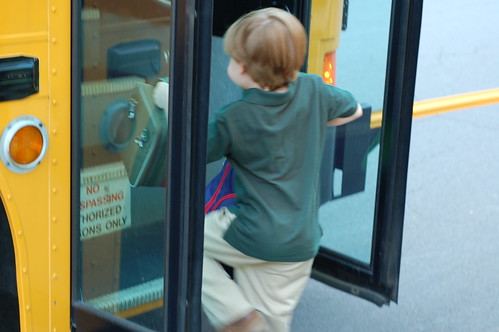
Ben hopped on the bus on Day 1 and never looked back. I don't mean that just figuratively - I have proof:

Of course, since Ben was already reading books for recreation, he had little to fear about the rigors of academia. That's not to say he hasn't learned anything, though. One evening during his second week I heard him call Ian an "idiot" during an argument, so his vocabulary is clearly expanding. Now that he has friends with older siblings, I imagine he'll learn much he simply hasn't been exposed to. I know my brother learned a lot years earlier than I, thanks to my lack of discretion. If you see a warning label on something, that means it's cool. Trust me.
Speaking of discretion, I also stepped into a new role that first week of school: that of an "adult." I don't mean the kind of adult who can vote, buy booze, and go to jail for real if one screws up, but the kind of adult who is feared by children. In other words, a true authority figure. At the back-to-school picnic I was picking up garbage behind the fence when one of a group of kids back there doing god-knows-what with all the hula hoops saw me and yelled "ADULT!" to his comrades, who promptly scattered. I might have interfered with whatever mischief they were up to had I not been momentarily blinded by power.
Kindergarten has given Ben a new sense of authority, too. He used to preface half of what he said with "You know what?" Not that he was ever asking a question, but his tone was generally inquisitive. Now he adds "you know" to the end of everything that comes out of his mouth, as if to say, This is in no way a question. I am making a statement of fact that is undeniable. I am in kindergarten, so I know. Actually it's more of a "yuh know," with an accent somewhere between Long Island and northern Minnesota. Which would put him right in the middle of Michigan, I guess. Huh.
I'm also discovering how true it is that parents make most of their friends through their kids once they start school. I've met more people in our neighborhood since he started kindergarten than I met in the entire year after we moved here. Everywhere we go, we're crossing paths with someone in Ben's class, or at least a fellow kindergartner at the same school. And Ben is either Mr. Popular or Mr. Forgetful, because everyone calls his name, but he never seems to know theirs. He puts up a good show, though, waving and treating everyone like a close friend while I exchange salutations with the parent, hearing and immediately forgetting the name. So I can do just what Ben is doing the next time we meet.
Poor Ian was none too pleased to return to his same old preschool after all the hullabaloo of Ben starting kindergarten. He wanted to go to a new school, too. Sorry kid, but you're not rich/dumb/poor enough for anything new. That's mostly good news. The best Ian got was a bump up to the next class level, which just so happens to be the one his brother just left, so all the teachers keep calling him Ben. Hardly a rarefied experience.
Don't worry, Ian. In a couple of years you'll be the one teaching your classmates all the cool stuff.
Ben hopped on the bus on Day 1 and never looked back. I don't mean that just figuratively - I have proof:
Of course, since Ben was already reading books for recreation, he had little to fear about the rigors of academia. That's not to say he hasn't learned anything, though. One evening during his second week I heard him call Ian an "idiot" during an argument, so his vocabulary is clearly expanding. Now that he has friends with older siblings, I imagine he'll learn much he simply hasn't been exposed to. I know my brother learned a lot years earlier than I, thanks to my lack of discretion. If you see a warning label on something, that means it's cool. Trust me.
Speaking of discretion, I also stepped into a new role that first week of school: that of an "adult." I don't mean the kind of adult who can vote, buy booze, and go to jail for real if one screws up, but the kind of adult who is feared by children. In other words, a true authority figure. At the back-to-school picnic I was picking up garbage behind the fence when one of a group of kids back there doing god-knows-what with all the hula hoops saw me and yelled "ADULT!" to his comrades, who promptly scattered. I might have interfered with whatever mischief they were up to had I not been momentarily blinded by power.
Kindergarten has given Ben a new sense of authority, too. He used to preface half of what he said with "You know what?" Not that he was ever asking a question, but his tone was generally inquisitive. Now he adds "you know" to the end of everything that comes out of his mouth, as if to say, This is in no way a question. I am making a statement of fact that is undeniable. I am in kindergarten, so I know. Actually it's more of a "yuh know," with an accent somewhere between Long Island and northern Minnesota. Which would put him right in the middle of Michigan, I guess. Huh.
I'm also discovering how true it is that parents make most of their friends through their kids once they start school. I've met more people in our neighborhood since he started kindergarten than I met in the entire year after we moved here. Everywhere we go, we're crossing paths with someone in Ben's class, or at least a fellow kindergartner at the same school. And Ben is either Mr. Popular or Mr. Forgetful, because everyone calls his name, but he never seems to know theirs. He puts up a good show, though, waving and treating everyone like a close friend while I exchange salutations with the parent, hearing and immediately forgetting the name. So I can do just what Ben is doing the next time we meet.
Poor Ian was none too pleased to return to his same old preschool after all the hullabaloo of Ben starting kindergarten. He wanted to go to a new school, too. Sorry kid, but you're not rich/dumb/poor enough for anything new. That's mostly good news. The best Ian got was a bump up to the next class level, which just so happens to be the one his brother just left, so all the teachers keep calling him Ben. Hardly a rarefied experience.
Don't worry, Ian. In a couple of years you'll be the one teaching your classmates all the cool stuff.
Friday, September 21, 2007
Tracking lesson
UPS
1) Receive email notification of shipment
2) Click on link to UPS website
3) Go back to email, copy tracking number
4) Return to UPS website, paste tracking number
5) Click button to track packages
6) Receive error message, search for box to click accepting mysterious Terms and Conditions without ever reading said Terms and Conditions
7) Click button to track packages again
8) Receive package status
DHL
1) Receive email notification of shipment
2) Click on link to DHL website, which immediately informs me of package status
Conclusion: Sometimes brown isn't just a brand. Sometimes it's just the color of shit.
1) Receive email notification of shipment
2) Click on link to UPS website
3) Go back to email, copy tracking number
4) Return to UPS website, paste tracking number
5) Click button to track packages
6) Receive error message, search for box to click accepting mysterious Terms and Conditions without ever reading said Terms and Conditions
7) Click button to track packages again
8) Receive package status
DHL
1) Receive email notification of shipment
2) Click on link to DHL website, which immediately informs me of package status
Conclusion: Sometimes brown isn't just a brand. Sometimes it's just the color of shit.
Friday, August 10, 2007
Alternate route advised
I park in a commercial lot several blocks from my office. The area bordered by North Capitol Street and First Street NE between M and N is pretty desolate, containing little more than fenced asphalt lots surrounded by overgrown urban flora, a municipal maintenance garage, and a nightclub. Every Monday morning the sidewalks within a hundred-yard radius are littered with the detritus discarded by the nightclubs patrons: flyers for upcoming shows, broken Heineken bottles, and general garbage searching in vain for a receptacle.
Across the street from the nightclub is a patch of earth that I imagine once supported grass, but is now firmly and frequently tamped by the resident homeless and whoever might stumble over to keep it real over the weekend. There is usually a group of men milling about when I drive past, but the scene usually looks more like a siesta than anything.
Yesterday I exited my parking lot onto N, and saw that down by the nightclub there were more people in the street than off, so I slowed, expecting them to move aside once they saw me approaching. Then I saw two of them locked in a struggle, one of them obviously on the defensive. At that point I stopped. It wasn't the first fight I've seen, and since the others appeared disinterested I half expected them to pause for traffic so I could proceed. While I was assessing the situation, however, the two broke apart, one ran to the curb and picked something up, then hurled it toward the other. When I heard the crack of a rock ricochet off the nightclub wall, I concluded that an alternate route was in order.
Fortunately my dad taught me to drive using my mirrors, so I immediately threw the car into reverse, confirmed that the road behind me was clear, and hightailed it back into my fenced lot. Not that there's a gate to keep people out, but at least it was half a block from the fight, and offered another exit to M Street. A couple of the guys ran toward me as I was backing away, but I think it's most likely they simply didn't want to be there when police responded to the 911 call I was placing.
I'm debating which route to take home tonight.
Across the street from the nightclub is a patch of earth that I imagine once supported grass, but is now firmly and frequently tamped by the resident homeless and whoever might stumble over to keep it real over the weekend. There is usually a group of men milling about when I drive past, but the scene usually looks more like a siesta than anything.
Yesterday I exited my parking lot onto N, and saw that down by the nightclub there were more people in the street than off, so I slowed, expecting them to move aside once they saw me approaching. Then I saw two of them locked in a struggle, one of them obviously on the defensive. At that point I stopped. It wasn't the first fight I've seen, and since the others appeared disinterested I half expected them to pause for traffic so I could proceed. While I was assessing the situation, however, the two broke apart, one ran to the curb and picked something up, then hurled it toward the other. When I heard the crack of a rock ricochet off the nightclub wall, I concluded that an alternate route was in order.
Fortunately my dad taught me to drive using my mirrors, so I immediately threw the car into reverse, confirmed that the road behind me was clear, and hightailed it back into my fenced lot. Not that there's a gate to keep people out, but at least it was half a block from the fight, and offered another exit to M Street. A couple of the guys ran toward me as I was backing away, but I think it's most likely they simply didn't want to be there when police responded to the 911 call I was placing.
I'm debating which route to take home tonight.
Monday, July 02, 2007
Cotton candy moustaches
If I had to pick one state of the weather to live with for the rest of my life, yesterday's would be it. Cool morning warming to the mid to high seventies, puffy clouds lazing about in the sky, low humidity (a miracle in this glorified swampland), nice breeze, bright sunshine that was comfortable even out of the shade. It might get boring after a while with no rain, sweltering heat or bitter cold, but I doubt it.
Ben was sick last week for his school trip to the zoo, so I promised him we would go this weekend. We arrived a little before noon, snagging one of the last parking spots, which was really an adversely possessed portion of the sidewalk. But why did they need a sidewalk at the end of a parking lot median anyway? I had seen others park there before, so I knew to take it quickly before the cars ahead of me circled the lot and came up empty. You know that guy everyone glares at for benefiting from prior experience? Yeah, that was me.
We meandered from one exhibit to the next, with no agenda and no sense of urgency. That's the best part of living so close to everything DC has to offer: we can take our time, and if we run out, we can always come back again. The pandas ticked off a lot of tourists by hiding in the back of their enclosure, but we've seen those lazy furballs several times, so it hardly mattered to us. Last time one was passed out in the shade giving everyone a nice clear view of only his yellowish butt; I saw a lot of cameras dejectedly tucked back into their bags.
Ben could hardly restrain himself the moment he spotted someone carrying cotton candy, because I'd told him we would have some if it were available. Tracking it down turned out to be a walking version of Where's Waldo. Neither of the two main cafés had any, and the one person I asked gestured vaguely uphill. We finally located it beyond the reptile house, and Ben suddenly forgot how tired his feet were and ran for it. I don't think Ian had ever had cotton candy before, but he showed no sign of his typical resistance to new food items before digging in with gusto. After a few bites, they seemed to get more enjoyment out of giving themselves pink moustaches than eating it. This is why I carry wetwipes with me at all times.


No wait. This provides a better sense of how useless a napkin would be against cotton candy (click for the full effect):

After that, I knew we needed to find an outlet for the coming sugar rush, stat. Fortunately the kids' play area wasn't too crowded, and they made friends to play tag with. Or something like tag. They mostly just chased each other around in circles, but somehow managed not to yak pink goo in the process. I don't think I had enough wetwipes for that.
By the time we made our way toward the exit, it was after 5:30. We'd spent nearly six hours at the zoo. We ducked into the barn to see the goats and donkeys, and on our way out a frenzied guy pushing a stroller asked me the fastest way to Amazonia (the rainforest exhibit) because it was closing in less than half an hour. His southern accent was so strong you could almost hear the cars sitting on blocks in his backyard, and he hollered to the rest of his family, "Come AWN! We see goats ever' DAY!" I am not making this up.
The rest of the day was sublime. We drove home with the windows down, and I played them Mrs. Robinson for the first time. Then the second. Then the third and maybe a couple of times more. Sound of Silence, Homeward Bound, Cecilia... Songs for driving and feeling groovy.
I picked the first ripe tomato from our garden, and it tasted better than any tomato I've ever bought. I'm now thoroughly hooked on gardening. The avocado I had at home was at its peak, and the two combined made for fantastic guacamole. I also discovered Stirrings Simple Mojito Mix at Whole Foods, making mojitos dangerously easy to make at home now. The boys mellowed out with Mr. Rogers, which made me feel all sappy and nostalgic.
And here I was worried about wrangling the kids solo for the weekend while Sarah is out of town. Pfft. We had a great time.
Ben was sick last week for his school trip to the zoo, so I promised him we would go this weekend. We arrived a little before noon, snagging one of the last parking spots, which was really an adversely possessed portion of the sidewalk. But why did they need a sidewalk at the end of a parking lot median anyway? I had seen others park there before, so I knew to take it quickly before the cars ahead of me circled the lot and came up empty. You know that guy everyone glares at for benefiting from prior experience? Yeah, that was me.
We meandered from one exhibit to the next, with no agenda and no sense of urgency. That's the best part of living so close to everything DC has to offer: we can take our time, and if we run out, we can always come back again. The pandas ticked off a lot of tourists by hiding in the back of their enclosure, but we've seen those lazy furballs several times, so it hardly mattered to us. Last time one was passed out in the shade giving everyone a nice clear view of only his yellowish butt; I saw a lot of cameras dejectedly tucked back into their bags.
Ben could hardly restrain himself the moment he spotted someone carrying cotton candy, because I'd told him we would have some if it were available. Tracking it down turned out to be a walking version of Where's Waldo. Neither of the two main cafés had any, and the one person I asked gestured vaguely uphill. We finally located it beyond the reptile house, and Ben suddenly forgot how tired his feet were and ran for it. I don't think Ian had ever had cotton candy before, but he showed no sign of his typical resistance to new food items before digging in with gusto. After a few bites, they seemed to get more enjoyment out of giving themselves pink moustaches than eating it. This is why I carry wetwipes with me at all times.

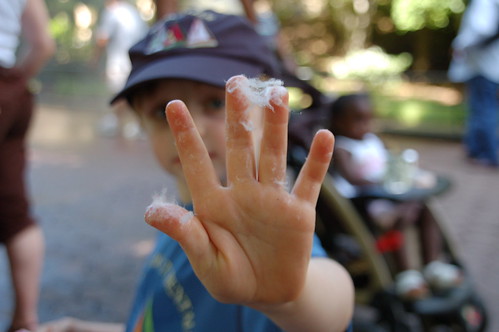
No wait. This provides a better sense of how useless a napkin would be against cotton candy (click for the full effect):

After that, I knew we needed to find an outlet for the coming sugar rush, stat. Fortunately the kids' play area wasn't too crowded, and they made friends to play tag with. Or something like tag. They mostly just chased each other around in circles, but somehow managed not to yak pink goo in the process. I don't think I had enough wetwipes for that.
By the time we made our way toward the exit, it was after 5:30. We'd spent nearly six hours at the zoo. We ducked into the barn to see the goats and donkeys, and on our way out a frenzied guy pushing a stroller asked me the fastest way to Amazonia (the rainforest exhibit) because it was closing in less than half an hour. His southern accent was so strong you could almost hear the cars sitting on blocks in his backyard, and he hollered to the rest of his family, "Come AWN! We see goats ever' DAY!" I am not making this up.
The rest of the day was sublime. We drove home with the windows down, and I played them Mrs. Robinson for the first time. Then the second. Then the third and maybe a couple of times more. Sound of Silence, Homeward Bound, Cecilia... Songs for driving and feeling groovy.
I picked the first ripe tomato from our garden, and it tasted better than any tomato I've ever bought. I'm now thoroughly hooked on gardening. The avocado I had at home was at its peak, and the two combined made for fantastic guacamole. I also discovered Stirrings Simple Mojito Mix at Whole Foods, making mojitos dangerously easy to make at home now. The boys mellowed out with Mr. Rogers, which made me feel all sappy and nostalgic.
And here I was worried about wrangling the kids solo for the weekend while Sarah is out of town. Pfft. We had a great time.
Wednesday, June 20, 2007
Swedish engineering is still subject to the limitations of aging rubber and fiber
We have a Swedish washing machine in our house - a front-loading, water-conserving machine by a company I've never heard of (Asko). The other day it stopped working, leaving a load of laundry soggy but unwashed. I initially blamed the power outage we'd experienced over the weekend, but putting it through another wash cycle only made the clothes a bit soggier. A bit smellier, too, since the load had now been sitting for a couple of days. And we're talking workout clothes and underwear here, so I imagine 300 bacterial Spartans had now become 300 billion, preparing not only to defend their territory but establish a vast empire.
Ordinary people might call the landlord or a repair shop at this point, but not I. No, I inherited my dad's DIY mentality, which generally means If I can't do it myself, I'll at least get to the point where I'm sure I can't.
Being an avid diagnostician - and feeling a special bond with this machine born in the land of my ancestors - I was pretty sure that there was a problem with the drive belt. Sure enough, it had snapped and lay coiled neatly below the drive motor. Our neighborhood hardware shop somehow always has what I need (Car battery terminal? Yup! Programmable thermostat? Sure! Hollow-point torx wrench? YOUHAVEGOTTOBEKIDDINGME!) to look for a replacement, but my luck was sure to run out sooner or later. I can't find a local supplier for this brand to save my life, so I went online to find somewhere to order a replacement. As luck would have it I found a place, and they'll even do same-day shipping. Even better, you can order online and pick up in their store!
But they only have one retail store for local pickup. And where is it? Canton, Michigan. Five minutes from where we used to live. Figures.
Ordinary people might call the landlord or a repair shop at this point, but not I. No, I inherited my dad's DIY mentality, which generally means If I can't do it myself, I'll at least get to the point where I'm sure I can't.
Being an avid diagnostician - and feeling a special bond with this machine born in the land of my ancestors - I was pretty sure that there was a problem with the drive belt. Sure enough, it had snapped and lay coiled neatly below the drive motor. Our neighborhood hardware shop somehow always has what I need (Car battery terminal? Yup! Programmable thermostat? Sure! Hollow-point torx wrench? YOUHAVEGOTTOBEKIDDINGME!) to look for a replacement, but my luck was sure to run out sooner or later. I can't find a local supplier for this brand to save my life, so I went online to find somewhere to order a replacement. As luck would have it I found a place, and they'll even do same-day shipping. Even better, you can order online and pick up in their store!
But they only have one retail store for local pickup. And where is it? Canton, Michigan. Five minutes from where we used to live. Figures.
Monday, June 11, 2007
Separation anxiety
This morning we stopped by the local elementary school to register Ben for kindergarten. I know - it seems like just yesterday he was running around the yard fighting with Ian over toys, making us cut the crust off his sandwich, and getting frustrated putting his sandals on. Oh wait - that was yesterday.
Anyway, Sarah ran in with a bunch of paperwork while I waited in the car with the boys. Ian wanted to go inside, but I explained that we weren't going to kindergarten quite yet; Ben would be going there at the end of the summer. Ben broke the news to Ian gently:
"I'm sorry, Ian. I'm going to kindergarten, but you're staying at my old school. I'll miss you."
"I'll miss you, too, Ben."
I'm not sure Ian fully understands that his big brother won't be nearby anymore. All I know is that it will be a sad day when reality sinks in.
Anyway, Sarah ran in with a bunch of paperwork while I waited in the car with the boys. Ian wanted to go inside, but I explained that we weren't going to kindergarten quite yet; Ben would be going there at the end of the summer. Ben broke the news to Ian gently:
"I'm sorry, Ian. I'm going to kindergarten, but you're staying at my old school. I'll miss you."
"I'll miss you, too, Ben."
I'm not sure Ian fully understands that his big brother won't be nearby anymore. All I know is that it will be a sad day when reality sinks in.
Wednesday, June 06, 2007
Ikea's tap runs dry
Being of Scandinavian descent, I appreciate Ikea's approach to selling furniture. Every aspect of furnishing a home - from manufacturing to shipping to the retail stores themselves - has been thoroughly examined in the effort to bring good design to the masses at low cost. Sure, I've been let down a few times by quality issues, like the folding chair that wouldn't unfold, but for the price I paid I could hardly complain. It's like getting Wal-Mart's Every Day Low Prices without the Every Day Low Standards.
And those meatballs! With the gravy and lingonberry sludge, I just can't help myself.
The Woodbridge, Virginia Ikea has become a recreational destination for us. It's only a short drive from home, and the boys actually nag us to go. Without family nearby, Småland (their supervised children's play area) offers our only respite from parenthood that doesn't cost $10-12 an hour. There was that one day we both called in sick after we dropped the kids off at preschool, but we really were sick, so that hardly counts. We don't have any room left in the house for even the smallest disposable housewares, but sometimes we'll just browse the labyrinthine floors and dream about being able to afford something that doesn't come packed into a flat box.
But this past weekend Ikea disappointed me. We went to the Ikea Cafe for a bite to eat before setting the boys free in Småland, and as I had done on prior visits, I grabbed a glass for some icewater. When I told the cashier that it wasn't for a soft drink, however, she informed me that my only options were soft drinks or bottled water. So I could buy something that's bad for my health, or something that's bad for the environment. Chagrined, I decided to take one for Kermit and headed for the lingonberry juice. When in Rome, you know. Or Stockholm.
Right there next to the lingonberry juice fountain was the Dispenser Formerly Known as Water, now stripped of its label and actuating lever. They didn't replace the water with another drink - they just disabled the water dispenser.
I would hardly consider myself an enviro-nazi (I've only seen Al Gore's movie once, figuring he would argue that repeated viewing would just waste energy), but I can't help finding this offensive. I didn't really want lingonberry juice. But I really really didn't want to send yet another unnecessary plastic bottle into the ecosystem. Even if Ikea recycles, energy and materials are still invested in the process, and it's better not to consume them at all. Reduce comes before Re-use and Recycle, doesn't it?
I can only assume that Ikea is attempting to pad its bottom line by closing a gap in its Cafe revenue, requiring customers to pay for any and all beverages. But is this the right way to do it? According to the New York Times, even upscale restaurants are switching from bottled water to tap water for environmental reasons. Whatever benefit they reap is surely outweighed by the bad karma.
Is a simple glass of water really too much to ask for?
And those meatballs! With the gravy and lingonberry sludge, I just can't help myself.
The Woodbridge, Virginia Ikea has become a recreational destination for us. It's only a short drive from home, and the boys actually nag us to go. Without family nearby, Småland (their supervised children's play area) offers our only respite from parenthood that doesn't cost $10-12 an hour. There was that one day we both called in sick after we dropped the kids off at preschool, but we really were sick, so that hardly counts. We don't have any room left in the house for even the smallest disposable housewares, but sometimes we'll just browse the labyrinthine floors and dream about being able to afford something that doesn't come packed into a flat box.
But this past weekend Ikea disappointed me. We went to the Ikea Cafe for a bite to eat before setting the boys free in Småland, and as I had done on prior visits, I grabbed a glass for some icewater. When I told the cashier that it wasn't for a soft drink, however, she informed me that my only options were soft drinks or bottled water. So I could buy something that's bad for my health, or something that's bad for the environment. Chagrined, I decided to take one for Kermit and headed for the lingonberry juice. When in Rome, you know. Or Stockholm.
Right there next to the lingonberry juice fountain was the Dispenser Formerly Known as Water, now stripped of its label and actuating lever. They didn't replace the water with another drink - they just disabled the water dispenser.
I would hardly consider myself an enviro-nazi (I've only seen Al Gore's movie once, figuring he would argue that repeated viewing would just waste energy), but I can't help finding this offensive. I didn't really want lingonberry juice. But I really really didn't want to send yet another unnecessary plastic bottle into the ecosystem. Even if Ikea recycles, energy and materials are still invested in the process, and it's better not to consume them at all. Reduce comes before Re-use and Recycle, doesn't it?
I can only assume that Ikea is attempting to pad its bottom line by closing a gap in its Cafe revenue, requiring customers to pay for any and all beverages. But is this the right way to do it? According to the New York Times, even upscale restaurants are switching from bottled water to tap water for environmental reasons. Whatever benefit they reap is surely outweighed by the bad karma.
Is a simple glass of water really too much to ask for?
Tuesday, June 05, 2007
15 seconds of fame
So there's this ridiculous internet fad called lolcats, where photos of innocent cats are given absurd captions for comic effect. Most of them imply that cats have horrific spelling and grammar, which couldn't be further from the truth. I'm guessing a dog started this whole thing. I mean seriously, can you imagine a cat uttering such nonsensical gibberish?

Considering how difficult it is to add text to an image, someone was bound to create a website that would help people with the process. Sure enough, about a month ago someone did. All of a sudden, anyone and everyone could create lolcats, and the fad snowballed. Even I succumbed, digging through the photos of our cats for promising candidates and giving them appropriately butchered captions.
Lolcats have become so prevalent that today the Houston Chronicle even published a story about them. And what should I find among their cited examples? None other than my very own lolcat, featuring our very relaxed Beatrice:

You know, I had hoped to be cited in the newspapers someday, but this isn't exactly what I'd envisioned.

Considering how difficult it is to add text to an image, someone was bound to create a website that would help people with the process. Sure enough, about a month ago someone did. All of a sudden, anyone and everyone could create lolcats, and the fad snowballed. Even I succumbed, digging through the photos of our cats for promising candidates and giving them appropriately butchered captions.
Lolcats have become so prevalent that today the Houston Chronicle even published a story about them. And what should I find among their cited examples? None other than my very own lolcat, featuring our very relaxed Beatrice:

You know, I had hoped to be cited in the newspapers someday, but this isn't exactly what I'd envisioned.
Tuesday, May 15, 2007
Part of the problem
The only downside of living in a city that is a popular tourist destination is having to compete with tourists. Once spring break arrives, whole herds of teenagers or senior citizens wearing matching T-shirts graze the food court at Union Station, where until now I've enjoyed a peaceful lunchtime most Fridays. I take some consolation in the fact that the stellar Indian food at Aditi is always overlooked in favor of pizza and chicken wings, so my wait in line isn't any longer than usual, but it's getting harder to find a seat. Last week I found a two-top next to three women at an adjacent table, and when I asked if anyone was sitting there, one responded "You are!" I didn't have to ask if they were from the Midwest. After a few minutes, though, others from their group started to gather, and before you know it I'm ceding the opposite side of my table, drafting food court treaty provisions in my head, hoping to finish my curry before everyone forgets I had a legitimate claim.
Being rather new to the area, there's still plenty we'd like to see ourselves, too. Fall and Winter were great times to catch up on a lot of stuff we hadn't seen in a while and explore the sights that were always too far down the priority list to cut the mustard when we were just visitors. Like the Theodore Roosevelt Island National Memorial. Didn't know there was a Theodore Roosevelt Memorial? Let alone an island? Yeah, neither did we. It holds up a commuter freeway, and since 9/11 airport traffic has passed directly overhead, so it's not exactly the remote wilderness Teddy may have wanted. If you like mosquitoes and goofy statues, though, do put it on your list.
For Mother's Day we had grand plans of visiting Great Falls Park, making an afternoon of nature's majesty just ten miles from home. So did everyone else, apparently, because a police car was blocking the entrance when we arrived, and most of the cars passing by could be seen turning around with disappointment on their faces. We were among them, but at least we could tell the kids we'd just come back another time - no big deal. So we resorted to Plan B:

Being rather new to the area, there's still plenty we'd like to see ourselves, too. Fall and Winter were great times to catch up on a lot of stuff we hadn't seen in a while and explore the sights that were always too far down the priority list to cut the mustard when we were just visitors. Like the Theodore Roosevelt Island National Memorial. Didn't know there was a Theodore Roosevelt Memorial? Let alone an island? Yeah, neither did we. It holds up a commuter freeway, and since 9/11 airport traffic has passed directly overhead, so it's not exactly the remote wilderness Teddy may have wanted. If you like mosquitoes and goofy statues, though, do put it on your list.
For Mother's Day we had grand plans of visiting Great Falls Park, making an afternoon of nature's majesty just ten miles from home. So did everyone else, apparently, because a police car was blocking the entrance when we arrived, and most of the cars passing by could be seen turning around with disappointment on their faces. We were among them, but at least we could tell the kids we'd just come back another time - no big deal. So we resorted to Plan B:

Friday, May 11, 2007
Security weakness by design
I have a pretty simple email address (only seven letters, no numbers or symbols), so I've gotten used to receiving emails meant for other people. It's not spam - it was meant for an individual person, just not me. I usually reply with a "Sorry, wrong email address," and that's that. Most of the time, I get an apology or a "Thanks for letting me know." One real estate agent tried to sell me a house while he had my attention even though I wasn't the intended client, but that's rare.
The messages I've received by accident have ranged from the mundane (forwarded jokes, baby pictures, nice-meeting-you-at-the-convention) to the embarrassing (think Taxicab Confessions). The first email that made me really worry about security issues, though, was from a hospital. A patient had made a mistake writing out her email address, so I ended up with correspondence that included home address, social security number, you name it. I immediately contacted the hospital to alert them of the error, and felt relieved that the information hadn't ended up in the wrong hands. I'm not sure what you'd do with the identity of someone from back-country Arkansas, but I've never wanted a credit card at Wal-Mart, either.
A few days ago I received an email asking me to confirm my email with some website called Plaxo. I'd never heard of it, so I assumed someone mistyped their email address again and deleted the message. The next day I received another email from Plaxo, then a couple more within hours. Assuming the message would keep coming, I looked for something to click on that would DISconfirm my address, but this is all the email contained:

I figured my problem needed "additional help," so I sent an email to validation@plaxo.com as instructed. The next day I received this response:

I tried to use the E-mail Validation Troubleshooter, but following the link took me to a login screen. Since it wasn't my account, I couldn't know the password, so I emailed Plaxo again, recounting my experience and telling them that there had been a mistake. The response?
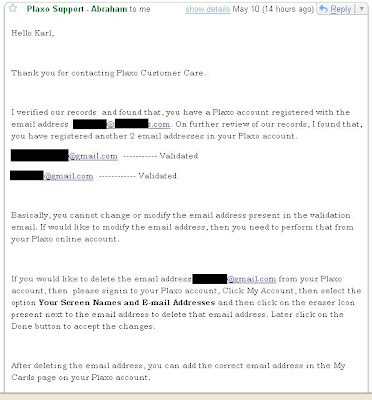
One of the three email addresses listed made it clear that their registered user's name was Kevin, but they went ahead and addressed their reply to Karl. Apparently, sending an email to validation@plaxo.com validated my email address, so now I'm anticipating a flood of emails meant to go to some guy whose typing skills leave something to be desired. I shot off yet another email to Plaxo, telling them that their confirmation process is a one-way street with no exit.
Then it hit me. If my email address had been confirmed, would I be able to claim that I had forgotten my password and get a new one sent to me? I returned to the Plaxo login screen, clicked on "Lost Password," entered my email address, and sent off the request. Within seconds, I received this:
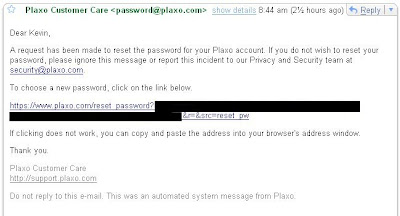
Followed the link, entered a new password, and I was in. All I wanted to do was get my email off of the account, but I could have taken whatever information I could find in this stranger's account. Scary.
This is an example of poor design leading to weak security. By not providing a way to say no to an email confirmation, anyone who received it in error could gain access to the intended user's account. Plaxo appears to be just an internet address book, but if a similar weakness existed elsewhere, a serious breach of privacy could arise. This isn't just a bad way to run a company - it's bad news for the users. Simple mistakes shouldn't lead to security lapses. Here's hoping that Plaxo can provide a bad example that others will learn by.
The messages I've received by accident have ranged from the mundane (forwarded jokes, baby pictures, nice-meeting-you-at-the-convention) to the embarrassing (think Taxicab Confessions). The first email that made me really worry about security issues, though, was from a hospital. A patient had made a mistake writing out her email address, so I ended up with correspondence that included home address, social security number, you name it. I immediately contacted the hospital to alert them of the error, and felt relieved that the information hadn't ended up in the wrong hands. I'm not sure what you'd do with the identity of someone from back-country Arkansas, but I've never wanted a credit card at Wal-Mart, either.
A few days ago I received an email asking me to confirm my email with some website called Plaxo. I'd never heard of it, so I assumed someone mistyped their email address again and deleted the message. The next day I received another email from Plaxo, then a couple more within hours. Assuming the message would keep coming, I looked for something to click on that would DISconfirm my address, but this is all the email contained:

I figured my problem needed "additional help," so I sent an email to validation@plaxo.com as instructed. The next day I received this response:

I tried to use the E-mail Validation Troubleshooter, but following the link took me to a login screen. Since it wasn't my account, I couldn't know the password, so I emailed Plaxo again, recounting my experience and telling them that there had been a mistake. The response?

One of the three email addresses listed made it clear that their registered user's name was Kevin, but they went ahead and addressed their reply to Karl. Apparently, sending an email to validation@plaxo.com validated my email address, so now I'm anticipating a flood of emails meant to go to some guy whose typing skills leave something to be desired. I shot off yet another email to Plaxo, telling them that their confirmation process is a one-way street with no exit.
Then it hit me. If my email address had been confirmed, would I be able to claim that I had forgotten my password and get a new one sent to me? I returned to the Plaxo login screen, clicked on "Lost Password," entered my email address, and sent off the request. Within seconds, I received this:

Followed the link, entered a new password, and I was in. All I wanted to do was get my email off of the account, but I could have taken whatever information I could find in this stranger's account. Scary.
This is an example of poor design leading to weak security. By not providing a way to say no to an email confirmation, anyone who received it in error could gain access to the intended user's account. Plaxo appears to be just an internet address book, but if a similar weakness existed elsewhere, a serious breach of privacy could arise. This isn't just a bad way to run a company - it's bad news for the users. Simple mistakes shouldn't lead to security lapses. Here's hoping that Plaxo can provide a bad example that others will learn by.
Wednesday, April 18, 2007
Recent photos
This is what happens when in snows in April in DC:


Ben:

Ian:

A short-lived cherry blossom:

Self-portrait with kite:



Ben:

Ian:

A short-lived cherry blossom:

Self-portrait with kite:

Monday, April 16, 2007
Life before modesty
Nearly five years after becoming a parent, the extent to which all parents are teachers keeps becoming clearer day by day. Depending on the knowledge of the parents, some subjects are best left to formal education (Art if the parents are engineers, Math if the parents are artists, for example). Sometimes, though, it's hard to curb a child's curiosity, and you find yourself in a corner looking for a quick exit. Tonight, while reading a book based on American Indian legend, Ben asked why there weren't any people in the story, and in my attempt to explain evolution to a five-year-old I'm pretty sure I left him imagining monkeys swinging through the jungle with human babies clinging to their fur. Oh well, better that than the alternative.
Other lessons parents offer are purely practical, like the fact that fire is hot and you'll get hurt if you touch it. Yesterday I was discussing corporal punishment with a friend, and we shared the view that some lessons require it in order to drive the point home. What do you do when your child reaches out toward a burner on the stove? Scold him? Let him burn himself? The former is woefully inadequate, and the latter is excessive (not to mention likely to earn you a file down at the child welfare agency).
The way I see it, some situations call for artful emotional scarring - something that will put The Fear in them such that further instruction is unnecessary. It's for their own good, of course. When discipline is generally administered through scolding and time-outs, a spanking might be the best way to send a message with the desired force; a little physical harm is intended to prevent a lot of physical harm. Sometimes a serious discussion might suffice if the danger is not imminent. This morning another friend of mine told me about a coworker who wanted to make sure her son never left her side while out in public, so she told him the story of Adam Walsh, the boy who was kidnapped and found murdered, and whose father went on to host American's Most Wanted. Now I'm not exactly sure how old her son was at the time, but that might be a bit too much emotional scarring for a kid to handle. Especially when you leave in details like decapitation. It apparently worked, but I can't help but wonder how the kid sleeps at night.
Sometimes the hardest lessons are the most subtle. Living in Washington, DC, Ben and Ian have probably seen more demonstrators than I did in my entire life before college. How do you explain war to a child? Whenever I try something like that, I feel like Mister Rogers on Xanax, attempting to explain suffering in happy terms. When Ben overheard me telling Sarah about today's murderous rampage at Virginia Tech, describing the killer as "not a nice person" who "hurt some people" seemed like the grossest understatement I'd ever made. There are some things you just don't want to know, kid.
Of course, not all the difficult lessons are depressing. Many are difficult because they're best taught by example. Not wanting to give my boys the impression that aggressive behavior and name-calling are appropriate, I've had to dial down the road rage during the daily commute and keep certain sentiments to myself. Which is hard in a city where the level of asshatted driving goes up to 11.
Last week we started reading Charlotte's Web before bedtime. Death is one of those difficult subjects, and I'm hoping the story will help Ben conceptualize certain facts of life. It might just turn him into a vegetarian, though. And here I was hoping that he'd at least be in high school before he started to guilt-trip me for my personal vices. Anyway, sometimes the challenging subjects have to do with the type of person I strive to be, and strive to raise my children to become. Tonight I finished a couple of short chapters, and told him that tomorrow we'd read Chapter Nine, "Wilbur's Boast."
"What's a boast?" Ben asked.
"Ummmm... a boast is when you talk too much about how good you are at something."
"..."
"Say you're really good at drawing (which you are). It's okay to tell people that you really enjoy drawing, but it's not really polite to always tell everyone that you're a really good drawer."
"Why is it not polite?"
"Well, if you tell someone you're really good at something, it might make them feel bad if they can't do it as well. What if someone told you they were a really good painter, and you weren't as good at painting? Would that make you feel bad?"
Ben shook his head and said, "It would make me want to be a better painter."
Here I am trying to teach modesty, and Ben comes back with soundbites from a motivational seminar. I don't know whether to feel proud of his self-assuredness and eagerness to learn, or afraid of his budding megalomania. I went with pride, telling him that was a good way to think about it, and he should always want to keep learning and practicing in order to succeed.
I can always tell when Ben is turning things over in his mind, because he gets quiet and still, and he's content to have me leave his bedroom without objection. Tonight was one of those nights. I don't know what he'll make of my efforts to teach him certain things, and who knows what the future holds, but these are the occasions when the responsibility of parenting really bears down on me. My only hope is that I get it right more often than I screw it up. And that my kids don't turn out Republican.
Other lessons parents offer are purely practical, like the fact that fire is hot and you'll get hurt if you touch it. Yesterday I was discussing corporal punishment with a friend, and we shared the view that some lessons require it in order to drive the point home. What do you do when your child reaches out toward a burner on the stove? Scold him? Let him burn himself? The former is woefully inadequate, and the latter is excessive (not to mention likely to earn you a file down at the child welfare agency).
The way I see it, some situations call for artful emotional scarring - something that will put The Fear in them such that further instruction is unnecessary. It's for their own good, of course. When discipline is generally administered through scolding and time-outs, a spanking might be the best way to send a message with the desired force; a little physical harm is intended to prevent a lot of physical harm. Sometimes a serious discussion might suffice if the danger is not imminent. This morning another friend of mine told me about a coworker who wanted to make sure her son never left her side while out in public, so she told him the story of Adam Walsh, the boy who was kidnapped and found murdered, and whose father went on to host American's Most Wanted. Now I'm not exactly sure how old her son was at the time, but that might be a bit too much emotional scarring for a kid to handle. Especially when you leave in details like decapitation. It apparently worked, but I can't help but wonder how the kid sleeps at night.
Sometimes the hardest lessons are the most subtle. Living in Washington, DC, Ben and Ian have probably seen more demonstrators than I did in my entire life before college. How do you explain war to a child? Whenever I try something like that, I feel like Mister Rogers on Xanax, attempting to explain suffering in happy terms. When Ben overheard me telling Sarah about today's murderous rampage at Virginia Tech, describing the killer as "not a nice person" who "hurt some people" seemed like the grossest understatement I'd ever made. There are some things you just don't want to know, kid.
Of course, not all the difficult lessons are depressing. Many are difficult because they're best taught by example. Not wanting to give my boys the impression that aggressive behavior and name-calling are appropriate, I've had to dial down the road rage during the daily commute and keep certain sentiments to myself. Which is hard in a city where the level of asshatted driving goes up to 11.
Last week we started reading Charlotte's Web before bedtime. Death is one of those difficult subjects, and I'm hoping the story will help Ben conceptualize certain facts of life. It might just turn him into a vegetarian, though. And here I was hoping that he'd at least be in high school before he started to guilt-trip me for my personal vices. Anyway, sometimes the challenging subjects have to do with the type of person I strive to be, and strive to raise my children to become. Tonight I finished a couple of short chapters, and told him that tomorrow we'd read Chapter Nine, "Wilbur's Boast."
"What's a boast?" Ben asked.
"Ummmm... a boast is when you talk too much about how good you are at something."
"..."
"Say you're really good at drawing (which you are). It's okay to tell people that you really enjoy drawing, but it's not really polite to always tell everyone that you're a really good drawer."
"Why is it not polite?"
"Well, if you tell someone you're really good at something, it might make them feel bad if they can't do it as well. What if someone told you they were a really good painter, and you weren't as good at painting? Would that make you feel bad?"
Ben shook his head and said, "It would make me want to be a better painter."
Here I am trying to teach modesty, and Ben comes back with soundbites from a motivational seminar. I don't know whether to feel proud of his self-assuredness and eagerness to learn, or afraid of his budding megalomania. I went with pride, telling him that was a good way to think about it, and he should always want to keep learning and practicing in order to succeed.
I can always tell when Ben is turning things over in his mind, because he gets quiet and still, and he's content to have me leave his bedroom without objection. Tonight was one of those nights. I don't know what he'll make of my efforts to teach him certain things, and who knows what the future holds, but these are the occasions when the responsibility of parenting really bears down on me. My only hope is that I get it right more often than I screw it up. And that my kids don't turn out Republican.
Wednesday, April 11, 2007
Peanuts
I was never much into Peanuts, but when this strip was published, I immediately cut it out of the Sunday comics and laminated it. Something about it struck me, and it's my favorite single comic strip to this day. I would probably call Calvin & Hobbes my favorite comic overall, but I can't say there was one in particular that I felt summed things up for me personally as succinctly as this single day's Peanuts.
 Whether or not Charles Schulz had anything particular in mind when he wrote this, he had the good sense to leave it up in the air so nearly anyone can identify. There are any number of reasons to believe that the world has gone mad. It would be easy to make a statement regarding apathy, but Schulz went beyond that. By having Charlie and Sally reassure Snoopy when he barks at their window, I think Schulz is offering a more complicated commentary on complacency. Your watchdog might be looking out for you, but sometimes it's the intangible that is the greatest menace.
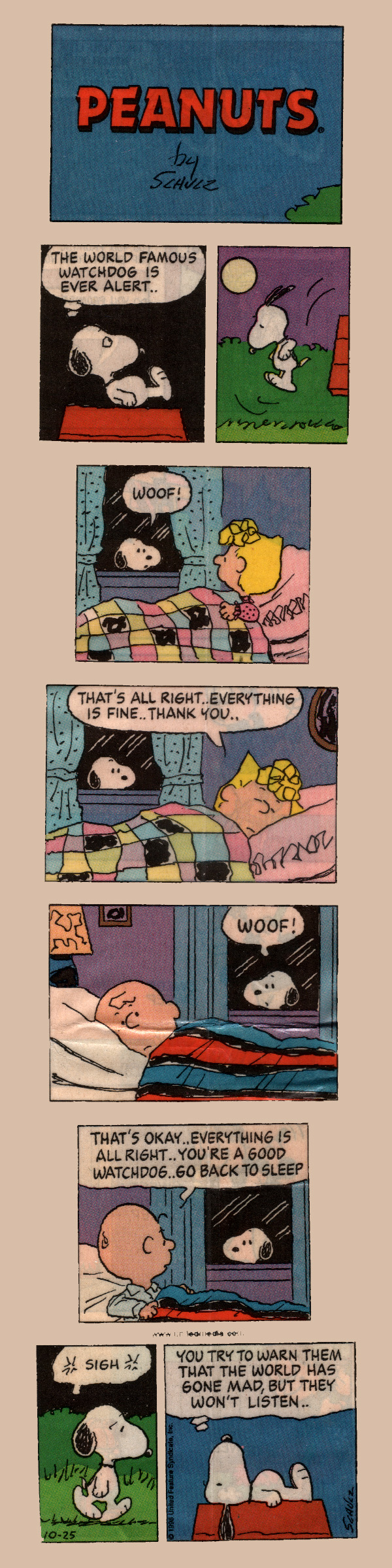 Whether or not Charles Schulz had anything particular in mind when he wrote this, he had the good sense to leave it up in the air so nearly anyone can identify. There are any number of reasons to believe that the world has gone mad. It would be easy to make a statement regarding apathy, but Schulz went beyond that. By having Charlie and Sally reassure Snoopy when he barks at their window, I think Schulz is offering a more complicated commentary on complacency. Your watchdog might be looking out for you, but sometimes it's the intangible that is the greatest menace.
Monday, April 02, 2007
Tuesday, March 27, 2007
If I had a little money...
During my commute home this evening, I stopped at the intersection of Constitution and 23rd beside an impeccable 80s-vintage Rolls Royce. I checked out who was behind the wheel - because that's what people behind the wheel of Rolls Royces want - and saw a white-haired baby boomer who looked like he bought the car new with gold bars from the family vault. His windows were rolled down, and I could hear the music he was playing:
Abba.
"Money Money Money."
It's a rich man's world, indeed.
Abba.
"Money Money Money."
It's a rich man's world, indeed.
Wednesday, March 21, 2007
School dress codes
There's an article in today's San Francisco Chronicle with the headline: "Fighting for the right to wear Tigger." In a nutshell, a 7th-grader landed in detention because her socks did not conform to the school's dress code. On Monday, the American Civil Liberties Union filed suit against the school district on behalf of six students and their parents, claiming that school policy violates their constitutional rights. According to the article:
Or litigation, apparently.
The Napa Valley Unified School District's dress code permits solid colors only, with pictures and logos strictly forbidden. So, naturally, one student considers it perfectly reasonable to wear argyle socks with Tigger on them. That or she doesn't care one wit about the oppressive dress code. I'm betting on the latter.
Someone's obviously itching for a fight, and the parents obviously have little regard for the dress code as well. Why shouldn't my baby be allowed to wear Tigger socks?
Well, there are several reasons. District Superintendent John Glaser has said that the dress code is intended "to ensure the safety and protect the instructional time of all students." The principal of the school in question, Michael Pearson, says "We do not have to deal with issues of kids who are dressing a certain way because their parents are able to shop at the fashionable stores. You cannot tell on my campus the kids that come from a low-income family." They're not alone; the U.S. Department of Education has also supported these views.
I'm with the schools.
People who sue the school district because their child was sent home for violating the dress code infuriate me. These same people probably complain every time their property taxes go up, too, all the while pursuing costly litigation against the school district. Brilliant.
There are better ways to show your disdain for school policies. You want to show The Man you think the rules are ridiculous? The most effective way is to operate within the rules while exploiting their weaknesses.
Personal anecdote time:
I went to a Catholic junior high and high school. Until the 1970s, it was a coat-and-tie establishment. By the time I got there, the dress code had grown lax, requiring little more than casual dress pants and a button-down shirt. In my sophomore year, they outlawed flannel shirts; you can imagine the ire that arose as a result in 1991-92. The next year they tightened the reigns a bit further, but I don't remember how. For my senior year, they reinstituted the requirement to wear a tie.
HOWEVER: They didn't specify much regarding the tie you had to wear. This was probably in deference to Mr. Hall, one of the English teachers, who never wore the same tie twice in a given year. He had a closet in his classroom full of them, including a gag tie that reached all the way to the floor. Not even the administration was going to crack down on this old fossil.
So I made it my mission to wear the most outrageous, hideous ties I could find. Some I found in my dad's closet, and some I bought at the thrift store. For a couple of months straight I wore the same tie, but I modified it every day with various colored markers. One day I burned a hole in it at lunch. My coup de grâce, however, was the day I slipped it over a straightened wire coathanger before putting it on. Throughout the day I could bend it into different shapes. When I walked by the assistant principal with my tie jutting straight out from my chest, I was finally forced to take it off and put on a normal tie. Everyone in the principal's office was laughing, though - even the staff.
Why must righteous indignation always lead to legal action? If students want to fight school policy, then they should do so while demonstrating their ability to function within the system. If parents want to fight school policy, then they should run for the school board or support candidates who share their ideals. Random carelessness is no way to achieve your goal.
Maybe the problem starts at home, not in the schools. In order for my kids to appreciate the flexibility of school policy, I'll just have to make the dress code at home even stricter. Solid colors? Plural? Forget that noise. From this day forward, unless they're heading to or returning from school, all clothing must be black. Head to toe.
They'll look just like Sarah did in high school.
The school's "unconstitutionally vague, overbroad and restrictive uniform dress code policy'' flouts state law, violates freedom of expression, and wastes teachers' and students' time and attention that would be better spent on education.
Or litigation, apparently.
The Napa Valley Unified School District's dress code permits solid colors only, with pictures and logos strictly forbidden. So, naturally, one student considers it perfectly reasonable to wear argyle socks with Tigger on them. That or she doesn't care one wit about the oppressive dress code. I'm betting on the latter.
Toni Kay, now an eighth-grade honors student, said Tuesday that she's been cited more than a dozen times in the last 1 1/2 years, and sent home from school twice
Someone's obviously itching for a fight, and the parents obviously have little regard for the dress code as well. Why shouldn't my baby be allowed to wear Tigger socks?
Well, there are several reasons. District Superintendent John Glaser has said that the dress code is intended "to ensure the safety and protect the instructional time of all students." The principal of the school in question, Michael Pearson, says "We do not have to deal with issues of kids who are dressing a certain way because their parents are able to shop at the fashionable stores. You cannot tell on my campus the kids that come from a low-income family." They're not alone; the U.S. Department of Education has also supported these views.
I'm with the schools.
People who sue the school district because their child was sent home for violating the dress code infuriate me. These same people probably complain every time their property taxes go up, too, all the while pursuing costly litigation against the school district. Brilliant.
There are better ways to show your disdain for school policies. You want to show The Man you think the rules are ridiculous? The most effective way is to operate within the rules while exploiting their weaknesses.
Personal anecdote time:
I went to a Catholic junior high and high school. Until the 1970s, it was a coat-and-tie establishment. By the time I got there, the dress code had grown lax, requiring little more than casual dress pants and a button-down shirt. In my sophomore year, they outlawed flannel shirts; you can imagine the ire that arose as a result in 1991-92. The next year they tightened the reigns a bit further, but I don't remember how. For my senior year, they reinstituted the requirement to wear a tie.
HOWEVER: They didn't specify much regarding the tie you had to wear. This was probably in deference to Mr. Hall, one of the English teachers, who never wore the same tie twice in a given year. He had a closet in his classroom full of them, including a gag tie that reached all the way to the floor. Not even the administration was going to crack down on this old fossil.
So I made it my mission to wear the most outrageous, hideous ties I could find. Some I found in my dad's closet, and some I bought at the thrift store. For a couple of months straight I wore the same tie, but I modified it every day with various colored markers. One day I burned a hole in it at lunch. My coup de grâce, however, was the day I slipped it over a straightened wire coathanger before putting it on. Throughout the day I could bend it into different shapes. When I walked by the assistant principal with my tie jutting straight out from my chest, I was finally forced to take it off and put on a normal tie. Everyone in the principal's office was laughing, though - even the staff.
Why must righteous indignation always lead to legal action? If students want to fight school policy, then they should do so while demonstrating their ability to function within the system. If parents want to fight school policy, then they should run for the school board or support candidates who share their ideals. Random carelessness is no way to achieve your goal.
Maybe the problem starts at home, not in the schools. In order for my kids to appreciate the flexibility of school policy, I'll just have to make the dress code at home even stricter. Solid colors? Plural? Forget that noise. From this day forward, unless they're heading to or returning from school, all clothing must be black. Head to toe.
They'll look just like Sarah did in high school.
Wednesday, March 07, 2007
Free Music Meets Free Market
The other day there was a story posted to Digg about Barenaked Ladies. No, not barenaked ladies - Barenaked Ladies. They're a rock band. If you haven't heard of them, I'm sorry that you've been missing out for nigh on fifteen years. Hard to believe I picked up their first CD half a lifetime ago, but it's true.
But this isn't about Barenaked Ladies. It's about Amie Street, an online music store that just started offering their new album. Like the much better known iTunes Store run by Apple, Amie Street sells music over the web. Amie Street is very much unlike the iTunes Store, however, in two key regards. First, the music is DRM-free, which may or may not be important to you. If you know what DRM stands for, it probably is.
Even more interesting, however, is Amie Street's pricing structure. While 99 cents per song is pretty much the industry standard, all music on Amie Street starts out entirely free. That's right, free. But only to the first customers through the door. As more customers show up to buy a particular song, the price increases gradually, maxing out at 98 cents.
Sound like a revolutionary business plan? It is, and here's why. I've seen a variety of selling strategies before: artists giving away music for free, letting buyers name the price, etc. But Amie Street is unique in the way its pricing structure has the potential to benefit both listeners and artists.
It's all about surplus. Surplus, in economics, is essentially a measure of how well someone made out at the negotiation table. In the world of buyers and sellers, there are always buyers who feel they got a great deal, and sellers pleased with the amount they squeezed out of the buyers. Say the negotiated price for a record is $10. If the buyer went to the table willing to pay $13, then his surplus is $3 - the amount he was willing to shell out but didn't have to. If the seller, on the other hand, would have gone as low as $7 before walking away, then her surplus is also $3 - the amount she got paid above what she was willing to accept. Equilibrium, in the classic sense, is the point at which both sides feel they got a fair deal, but nothing to brag about.
What's revolutionary about Amie Street is the way its model hands all the surplus over to the buyers. Here's a graph of the classic version of supply and demand, with shaded areas showing the surplus:

Amie Street's model is different. While I don't know exactly how many songs they will sell at a given price, I imagine their supply curve looks something like this:

Even at a price of $0, Amie Street will sell some number of songs. As the quantity sold rises, though, so does the price. Once the price hits 98 cents, the supply curve plateaus. Why? Because at that price, Amie Street will sell to however many buyers come along. The final sales figure is entirely dependent on demand. The profit is the same for each additional song sold at full price, and Amie Street shares the bulk of the wealth with the artist (70% according to the website).
The interesting stuff happens among the buyers. Barenaked Ladies are a popular group; overall demand is pretty high. Within hours of their new songs appearing on Amie Street, the price had climbed to the full 98 cents on all but a few, and all were selling for the maximum price after only a day. The lucky few who bought early made out like bandits: some paid nothing, while many others surely paid far less than they would have otherwise. All that surplus ended up in the buyers' pockets. Amie Street sold each song for exactly what it was willing to accept; there was no surplus whatsoever on the supply side. The graph now looks like this:

All that blue makes for happy buyers.
So that's an illustration of how Amie Street's business model benefits consumers. But why would any rational seller give away all that surplus? Wouldn't Amie Street and the artists who sell on the site make more money if they just started the price at 98 cents? Heck, why not charge twice as much when songs first come out to take advantage of the ardent fans who want the new material as soon as possible no matter what the cost? Turn all that blue to red, and capture the surplus for the seller.
That might work for some artists, especially the most popular ones with the largest fan base. But for others - particularly relative unknowns - Amie Street's model has the potential to grow their market and reap greater rewards in the long run.
See, Amie Street's pricing structure encourages early adoption. That is, by dangling the carrot of free downloads, they encourage buyers to seek out and discover new music. Not everything is guaranteed to be good, but diamonds in the rough certainly stand a better chance of being found. Like a song but don't love it? You might not be willing to shell out 98 cents, but a dime? Sure! It might even grow on you over time, so you recommend it to a friend, who might also like it enough to buy it at a lower price. If the product is good enough, this process repeats, and the fan base grows.
Lots of artists rely on word of mouth to expand their audience, but Amie Street gives them the potential to accelerate the process. It's hard to imagine the obstacles between buyer and seller being lowered much further than offering free downloads over the web; all it takes is a little initiative to bridge the gap. Amie Street's supply curve is always the same, but as the audience grows, demand grows, and the demand curve shifts.

The greater the demand, the higher the sales. Higher sales means more money for both Amie Street and the artist. With enough success, the surplus given away by the seller may be entirely recouped.
If the product is good enough, an artist might ultimately find its songs selling for full price, without any of the marketing and production costs typically spent by major labels. The costs of distribution through Amie Street are almost entirely marginal (per unit rather than a large fixed sum), so it is easier for artists to get their music into the market. Even for Amie Street much of the cost of operation is marginal; bandwidth in particular is a perfect example of a marginal cost.
My gut reaction when I first read about Amie Street was that it was another marketing gimmick. But the more I think about it, the more I think they're re-writing the rules of the music industry. For years there have been questions about the long-term viability of making music, and there have been plenty of losses along the way. Amie Street might have on its hands a practical solution that pleases both buyers and sellers simultaneously. If it catches on, it might be leading a revolution.
But this isn't about Barenaked Ladies. It's about Amie Street, an online music store that just started offering their new album. Like the much better known iTunes Store run by Apple, Amie Street sells music over the web. Amie Street is very much unlike the iTunes Store, however, in two key regards. First, the music is DRM-free, which may or may not be important to you. If you know what DRM stands for, it probably is.
Even more interesting, however, is Amie Street's pricing structure. While 99 cents per song is pretty much the industry standard, all music on Amie Street starts out entirely free. That's right, free. But only to the first customers through the door. As more customers show up to buy a particular song, the price increases gradually, maxing out at 98 cents.
Sound like a revolutionary business plan? It is, and here's why. I've seen a variety of selling strategies before: artists giving away music for free, letting buyers name the price, etc. But Amie Street is unique in the way its pricing structure has the potential to benefit both listeners and artists.
It's all about surplus. Surplus, in economics, is essentially a measure of how well someone made out at the negotiation table. In the world of buyers and sellers, there are always buyers who feel they got a great deal, and sellers pleased with the amount they squeezed out of the buyers. Say the negotiated price for a record is $10. If the buyer went to the table willing to pay $13, then his surplus is $3 - the amount he was willing to shell out but didn't have to. If the seller, on the other hand, would have gone as low as $7 before walking away, then her surplus is also $3 - the amount she got paid above what she was willing to accept. Equilibrium, in the classic sense, is the point at which both sides feel they got a fair deal, but nothing to brag about.
What's revolutionary about Amie Street is the way its model hands all the surplus over to the buyers. Here's a graph of the classic version of supply and demand, with shaded areas showing the surplus:
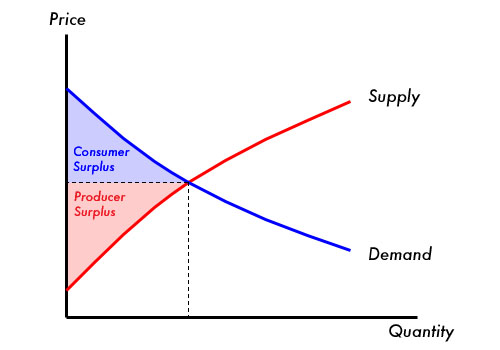
Amie Street's model is different. While I don't know exactly how many songs they will sell at a given price, I imagine their supply curve looks something like this:
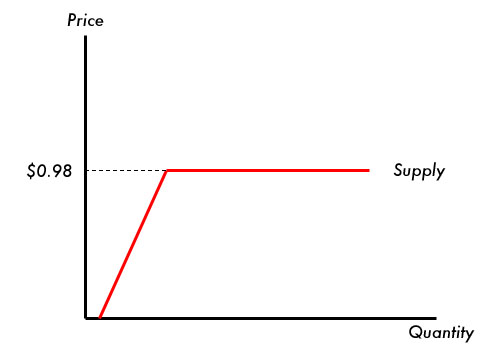
Even at a price of $0, Amie Street will sell some number of songs. As the quantity sold rises, though, so does the price. Once the price hits 98 cents, the supply curve plateaus. Why? Because at that price, Amie Street will sell to however many buyers come along. The final sales figure is entirely dependent on demand. The profit is the same for each additional song sold at full price, and Amie Street shares the bulk of the wealth with the artist (70% according to the website).
The interesting stuff happens among the buyers. Barenaked Ladies are a popular group; overall demand is pretty high. Within hours of their new songs appearing on Amie Street, the price had climbed to the full 98 cents on all but a few, and all were selling for the maximum price after only a day. The lucky few who bought early made out like bandits: some paid nothing, while many others surely paid far less than they would have otherwise. All that surplus ended up in the buyers' pockets. Amie Street sold each song for exactly what it was willing to accept; there was no surplus whatsoever on the supply side. The graph now looks like this:
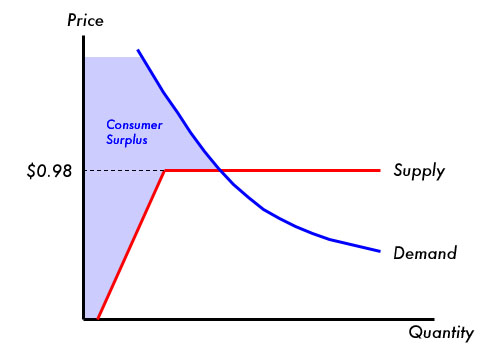
All that blue makes for happy buyers.
So that's an illustration of how Amie Street's business model benefits consumers. But why would any rational seller give away all that surplus? Wouldn't Amie Street and the artists who sell on the site make more money if they just started the price at 98 cents? Heck, why not charge twice as much when songs first come out to take advantage of the ardent fans who want the new material as soon as possible no matter what the cost? Turn all that blue to red, and capture the surplus for the seller.
That might work for some artists, especially the most popular ones with the largest fan base. But for others - particularly relative unknowns - Amie Street's model has the potential to grow their market and reap greater rewards in the long run.
See, Amie Street's pricing structure encourages early adoption. That is, by dangling the carrot of free downloads, they encourage buyers to seek out and discover new music. Not everything is guaranteed to be good, but diamonds in the rough certainly stand a better chance of being found. Like a song but don't love it? You might not be willing to shell out 98 cents, but a dime? Sure! It might even grow on you over time, so you recommend it to a friend, who might also like it enough to buy it at a lower price. If the product is good enough, this process repeats, and the fan base grows.
Lots of artists rely on word of mouth to expand their audience, but Amie Street gives them the potential to accelerate the process. It's hard to imagine the obstacles between buyer and seller being lowered much further than offering free downloads over the web; all it takes is a little initiative to bridge the gap. Amie Street's supply curve is always the same, but as the audience grows, demand grows, and the demand curve shifts.
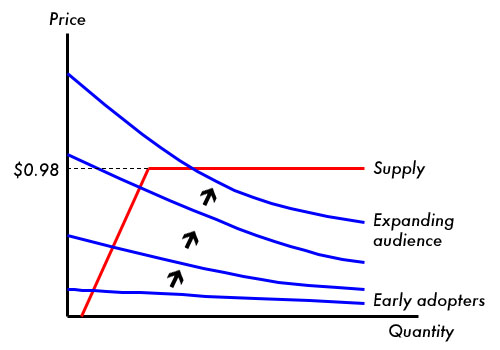
The greater the demand, the higher the sales. Higher sales means more money for both Amie Street and the artist. With enough success, the surplus given away by the seller may be entirely recouped.
If the product is good enough, an artist might ultimately find its songs selling for full price, without any of the marketing and production costs typically spent by major labels. The costs of distribution through Amie Street are almost entirely marginal (per unit rather than a large fixed sum), so it is easier for artists to get their music into the market. Even for Amie Street much of the cost of operation is marginal; bandwidth in particular is a perfect example of a marginal cost.
My gut reaction when I first read about Amie Street was that it was another marketing gimmick. But the more I think about it, the more I think they're re-writing the rules of the music industry. For years there have been questions about the long-term viability of making music, and there have been plenty of losses along the way. Amie Street might have on its hands a practical solution that pleases both buyers and sellers simultaneously. If it catches on, it might be leading a revolution.
Subscribe to:
Posts (Atom)